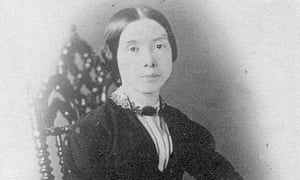
Biography
Emily Dickinson was a poet during the mid 19th century. She was born in Amherst on December 10, 1830, and died May 15, 1886. The cause of death is unknown but it is speculated that she died from heart failure induced by severe hypertension, otherwise known as high blood pressure. During her lifetime she wrote almost 1800 poems, as well as many letters, but only around 10 of her poems were ever published, either without her consent, or anonymously. Because of this, her poetry remained virtually unpublished until after her death, when her poems and life where brought to the attention of the rest of the world, through combined efforts by her family and friends.
Emily Dickinson was the middle child, born to Edward and Emily Norcross Dickinson. She was Born in the family homestead on Main Street in Amherst Massachusetts. She had an older brother named Austin and just 3 years after Emily was born, her little sister Lavinia was born. Her family remained in the homestead for 7 more years until Emily was 9, and at that time the family bought a house on what is now North Pleasant Street in Amherst. Emily’s schooling was exceptional for girls at the time, but not that unusual for girl who lived in Amherst. she first started at Amherst district school, than Amherst Academy, before finally entering Mount Holyoke Female Seminary in 1847. She spent only 1 year at the seminary, which is the longest amount of time she has ever spent away from home. As Emily grew older, she became more introverted, and started losing the social flair of her younger years.
Emily Dickinson lived near the town cemetery and had had the death of friends and relatives, which led to part of the reason she had a slight obsession with death in some of her poems. Another factor to this was that she was raised in a Calvinistic society which continually addressed the concern for the human soul. the interesting thing is that her friends and her family did join the church, but Emily never did.
the writing years of Emily began in her early 20’s when she had a few poems published anonymously. Even though this is when her writing first started, the most important time period of her writing is from 1858 to 1865, which does correlate with the time of the Civil War. This is also around a time period of her life that brought much change. in 1855 her father bought back the Homestead and in 1856 her brother Austin married a close friend of Emily’s, Susan Huntington Gilbert. Living with them, Emily did attend some social functions, but her lifestyle contrasted greatly with the couple. eventually the couple did have 3 children, Ned, Martha, and Gilbert, who did bring much joy to Emily’s life.
At age 35, Emily had written over 1100 poems, 800 of which were recorded in small booklets. though she kept most of her work private, she did share some with family and close friends. some of her work still remains a mystery, mainly the master letters, 3 drafts of letters all addressed to a man she called master.
Even though Emily was reclusive already, she became much more so after an eye treatment she had in the mid 1860’s, and now ventured rarely outside the Homestead. Also around this time is when she stops putting her poems in the little booklets. even though some wanted her to publish some more poetry she did not, but some of her poetry is thought to have been read at a women’s social gathering, and another was published in A Masque of Poets.
Though Emily Dickinson did have a romance in her latter life, her later life was marked with much illness and death. Her father, mother, her nephew, friend, and also her lover. Shortly after her nephew Gilbert’s death she fell ill, and eventually died. Emily Dickinson is Buried in what is know known as west Cemetery.
Information was obtained from https://www.emilydickinsonmuseum.org/
Favorite Poem
My favorite poem by Emily Dickinson would have to be Because I Could Not Stop for Death
Because I could not stop for Death –
He kindly stopped for me –
The Carriage held but just Ourselves –
And Immortality.

We slowly drove – He knew no haste
And I had put away
My labor and my leisure too,
For His Civility –

We passed the School, where Children strove
At Recess – in the Ring –
We passed the Fields of Gazing Grain –
We passed the Setting Sun –

Or rather – He passed us –
The Dews drew quivering and chill –
For only Gossamer, my Gown –
My Tippet – only Tulle –

We paused before a House that seemed
A Swelling of the Ground –
The Roof was scarcely visible –
The Cornice – in the Ground –

Since then – ‘tis Centuries – and yet
Feels shorter than the Day
I first surmised the Horses’ Heads
Were toward Eternity –
https://www.poets.org/poetsorg/poem/because-i-could-not-stop-death-479
This is my favorite poem because I think It really does speak truth to the way people do think. It’s in human nature to want to not die, to live forever in a sense, we want all of eternity, we don’t want to stop so that death can take us, but in the end, death takes us all, and there is nothing we can do to stop that. In the end though, I just find this poem beautiful in wording and meaning.
Literary Devices Emily Dickinson Used
Emily Dickinson used many literary devices in her works. here is where I discuss two different devices and two poem where those devices can be found.
Device 1: Metaphor, If I Shouldn’t be Alive “If I couldn’t thank you, / Being fast asleep, / You will know I’m trying / With my Granite Lip” (Dickinson 5-8).
This poem not only showcases two examples of Metaphor, but also is able to showcase a category of the poetry Emily Dickinson wrote about. Throughout Her life she wrote a good number of poems on death and in this one we look at how she likens death to a deep sleep, but also saying that her lip will be granite. The second one has slightly more meaning, because it reveals that this poem is not about the Robins or thank you’s, but about death in its finality, and how a corpses dead lifeless lips are like that cold hard granite of the tombstone, in texture and color. This describes how this person will never feed anymore birds, and lips say thank you, or anything else for that matter.
Device 2: Personification, Water is taught by thirst “Water, is taught by thirst. / Land-by the oceans passed. / Transport-by throe- / Peace-by its battles told- / Love, by Memorial Mold- / Birds, by the Snow” (Dickinson 1-6).
This entire poem is one big showcase of personification, albeit it is pretty much the same thing over and over. This tells the story of how when we thirst we need water, and how the lands that surround as needed the water to teach them how to form, in a sense. This continues on, but the point is that something must be taught by something else. That there had to be this, before this. This is one of the more interesting poems that I read, because it seems to go more on the lines of the nature of the world rather than other topics that get discussed in Emily’s Poetry like death and love, or the church. That is why I chose this poem. It is interesting in the fact that the whole poem is personification, but also that it does not go on the usual theme of her work.
Reason for Study
Finally, I discuss the reason for studying this poet, from a Christian standpoint, as well as what I personally connected with in her poetry.
This poet Is one who I believe, is worthy of study by Christians, because of her view on religion. She was religious, but she was not like others during her time. She worshiped slightly unconventionally, and she may have not attended services, and just stayed home to praise, but she was still a believer in God. Inside her poetry, we can see this interesting perspective on God, and are able to, possibly, gain a new view on our own faith. This all does make me think back to how all the information we have on her is in books and on the internet, and brings up the question on what information, personally, was I able to connect with most, and in truth, it was my own research found on the internet, because there is only so much an essay can tell you, but with so many websites out there, and so much information that is actually true on the internet, I am able to learn so much more. All this information gives just a slight glimpse of Emily Dickinson’s life, and it is truly, very interesting what you learn from it.
More Information
For more information on Emily Dickinson watch these video’s:
Or go to this website:

 Emily Dickinson, Poet